Overview
- Speaker shares insights from building, scaling, and selling companies worth $40 billion
- Five major business wins discussed, each with strategic lessons applicable to entrepreneurs
- Central theme: Success comes from playing differently, not following the crowd
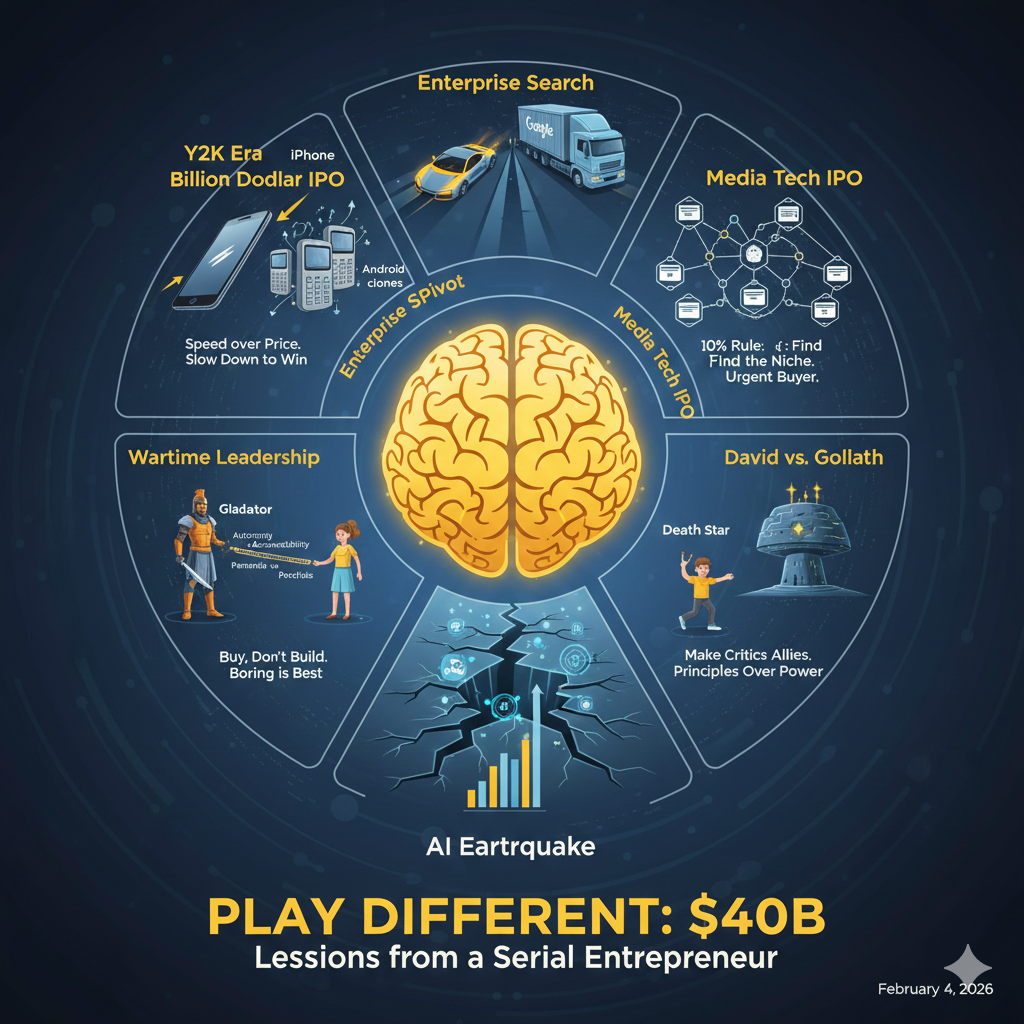
First Win: Y2K Era Billion Dollar IPO
- The opportunity: While companies raced to India for cheap engineers during Y2K panic, the speaker’s team identified a different market
- The strategy: Instead of selling cost reduction to Fortune 500 companies, they helped startups build products using global models, selling speed of execution rather than cheap labor
- Key lessons:
- The fastest way to win is to play a different game – don’t follow the crowd
- Never compete on price; position as premium provider (the “iPhone in a world of Android clones”)
- Watch the environment carefully – they paused their IPO when market showed fear, waited 18 months through a $5 trillion market crash, then achieved billion dollar valuation
- The irony: sold speed but won by slowing down
Second Win: Enterprise Search Pivot
- The context: Company had largest search index and fastest crawlers during early internet era, could find new pages in hours versus days
- The challenge: Google’s PageRank algorithm and auction-based pricing changed the game completely
- The pivot: Sold consumer search business (eventually to Yahoo) and shifted to enterprise search for large corporations
- The exit: Microsoft bought the company for $1.2 billion, needing a weapon to defend their enterprise turf against Google
- Key lessons:
- Giants are “like 18 wheelers, slow to turn, full of blind spots” – find what they can’t see and own that niche
- The “10% rule”: In a trillion dollar company’s shadow exists a $100B opportunity, and within that a $10B play – each layer is waiting to be taken
- Best exits happen when strategic buyer has an urgent need
Third Win: Multi-Billion Dollar Media Tech IPO
- The innovation: Built system that valued each search like a stock, pricing content before it was written
- The approach: Content engine generated thousands of articles monthly, each mapped to search demand
- The outcome: One of first multi-billion dollar media tech IPOs after 2008 crash
- Key lessons:
- Fastest way to scale: buy, don’t build – roll-ups accelerate growth if you know what to buy and how to integrate
- They bought websites, plugged them into their platform, turned each into traffic engine
- Biggest wins often in boring industries – examples include AI applied to Medicare, trucking, home appliances, claims processing
- Best way to disrupt old industries is to teach them new tricks
Fourth Win: Wartime Leadership Lessons
- The context: Led one of 20 fastest growing companies in US, couldn’t hire/build/scale fast enough
- Three leadership tightropes to walk:
- Gladiator vs. Gardener: Know when to fight and push team toward action (they may not like you) versus when to nurture, inspire, and tell them to slow down (they may love you)
- Autonomy vs. Accountability: Give team room to experiment but set guardrails – too much freedom leads to chaos, too much control creates drones
- Paranoia vs. Paralysis: Game worst case scenarios and build safety nets, but execute like there’s no plan B – healthy paranoia keeps you prepared but can also cause paralysis
- The days you don’t fall off these tightropes are great days
Fifth Win: David vs. Goliath Strategy Against Google
- The situation: Public company with advertising platform competing directly against Google – “odds weren’t just bad, they were impossible”
- The strategy: Every “Death Star has a tunnel, a single weak spot”
- Key lessons:
- Large incumbents always have critics – make the critics your ally and become David to their Goliath
- Stand for principles the larger competitor cannot – they stood for objectivity and independence where Google had conflicts of interest
- This playbook works across industries: Salesforce vs. Oracle, Spotify vs. Apple, Netflix vs. Blockbuster, Tesla vs. auto industry
- When you see an earthquake coming, don’t hesitate – seismic industry shifts create small windows of opportunity
- Examples of past earthquakes: client-server to internet, internet to search, search to social media, social media to mobile, mobile to cloud computing
- They capitalized on streaming platforms’ rise during and after COVID, resulting in 300% stock increase
The Next Opportunity: AI
- The AI earthquake is “perhaps the biggest one ever in our lifetime” and is already here
- Winners are moving fast, not hesitating
- Speaker references video about best AI businesses to start that AI cannot destroy