This presentation covers eight mental shifts that can transform communication skills, drawing from the speaker’s experience as a CEO and musician.
The Challenge of Human Communication
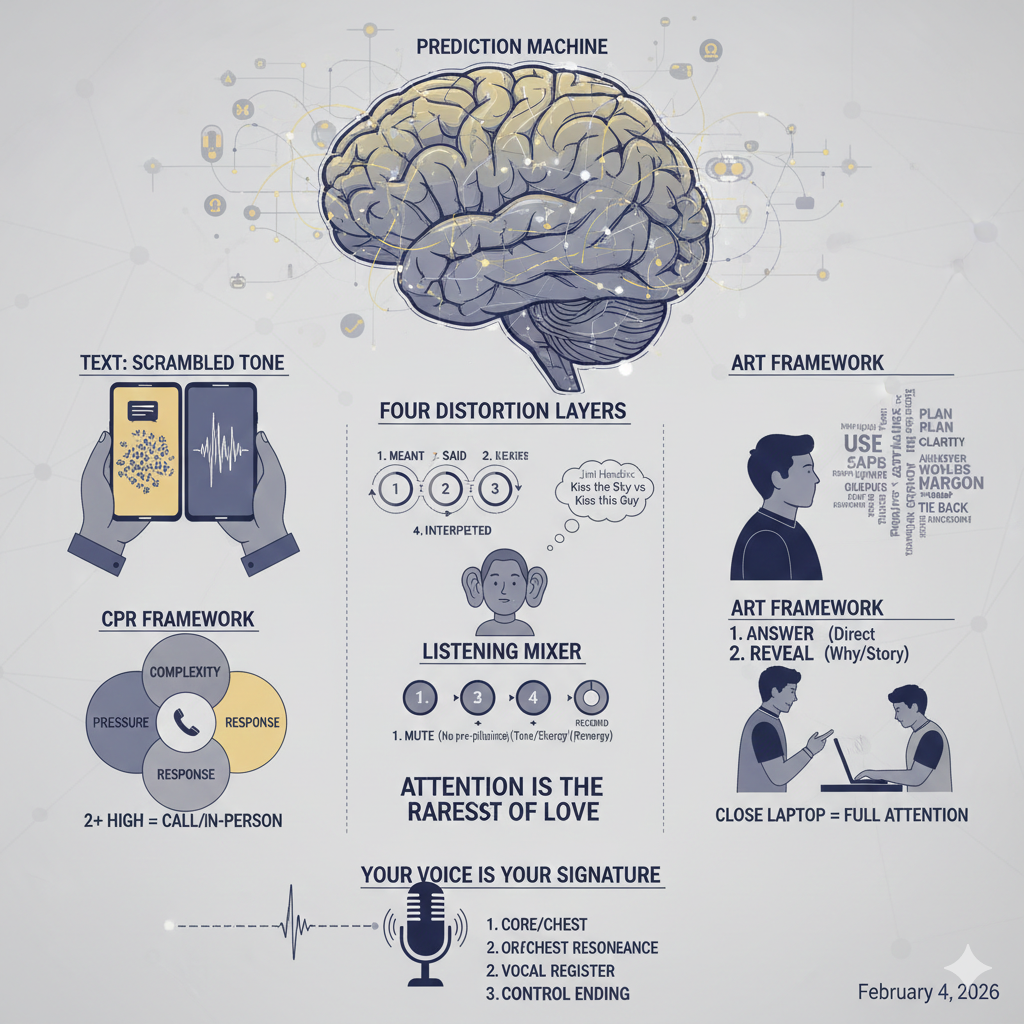
- The brain as a prediction machine: Humans don’t actually hear what people say – the brain hears what it wants to hear through pattern matching and prediction
- Research from neuroscientist Lisa Feldman Barrett shows the brain fills in meaning before sentences are complete
- Example: Millions heard Jimi Hendrix’s “While I Kiss the Sky” as “While I kiss this guy”
- Four layers of distortion: What you meant → what you said → what they heard → what they interpreted
Shift 1: Match Medium to Message
- General rule: Call when it matters, text when it’s safe
- Tone doesn’t travel through text – meaning gets scrambled through the medium
- CPR Framework for choosing the right communication medium:
- Complexity: Is the topic complicated?
- Pressure: Are the emotional stakes high?
- Response: Does it require two-way conversation?
- If at least two of these are high, pick up the phone or meet in person
- Avoid texting for feedback, conflict resolution, or giving comfort
Shift 2: True Listening
- Chris Rock’s observation: “People don’t really listen, they’re just waiting for their turn to talk”
- Listening requires full body-mind connection, not just polite nodding
- Listening Mixer Framework (like a DJ mixer with four buttons):
- Mute: Don’t think about what you’ll say next while someone speaks
- Pause: After they finish, take a breath and let silence happen
- Record: Read their tone, energy, and emotion; mirror what they said
- Playback: Only now speak, in the same emotional key to build trust
Shift 3: Stop Hiding Behind Words
- The speaker received critical feedback: “You hide behind your humor. You deflect. You use sarcasm instead of candor”
- Cognitive load theory: The harder someone has to work to understand you, the less they’ll remember
- Simplify language:
- Say “use” instead of “leverage”
- Say “plan” instead of “strategy”
- Avoid jargon and unnecessary complexity
Shift 4: The ART of Answering Under Pressure
- Many people ramble instead of directly answering tough questions
- ART Framework for high-stakes conversations:
- Answer: Start with the direct answer – don’t build up to the punchline
- Reveal: Add a reason, story, or insight explaining the why behind the what
- Tie it back: Loop back to the original question to show clarity
- Apply this in job interviews, client calls, and boardroom situations
Shift 5: Handling Panic and Freezing
- Personal example: As an equity analyst, the speaker froze during a high-stakes client call and hung up
- The prefrontal cortex goes offline during panic
- Recovery process: Deep breathing, calming down, seeking help, and calling back with the answer
- High performers shine because they don’t fall apart when panic happens – presence beats perfection
Shift 6: Voice Quality Matters
- Voice quality starts with breath quality
- Three techniques from opera training:
- Speak from your core or chest to improve resonance
- Find your right vocal register that makes your voice sound attractive
- Control the ending – avoid the “question mark” style where every sentence ends on a high note
- Practice by recording yourself and reviewing the audio/video
- In business and leadership, your voice is your instrument
Shift 7: Attention as Love
- Few people remember Dr. Martin Luther King’s full speech, but everyone remembers “I have a dream”
- Words matter because of the presence and emotion behind them
- Simple practice: Close the laptop or turn away the screen when someone enters to give full attention
- Core truth: Attention is the rarest form of love
Shift 8: Generosity in Communication
- Focus on the next conversation fully and without judgment
- One conversation could change someone’s life
- Generosity makes you the best communicator – give your attention, emotions, and intention to others