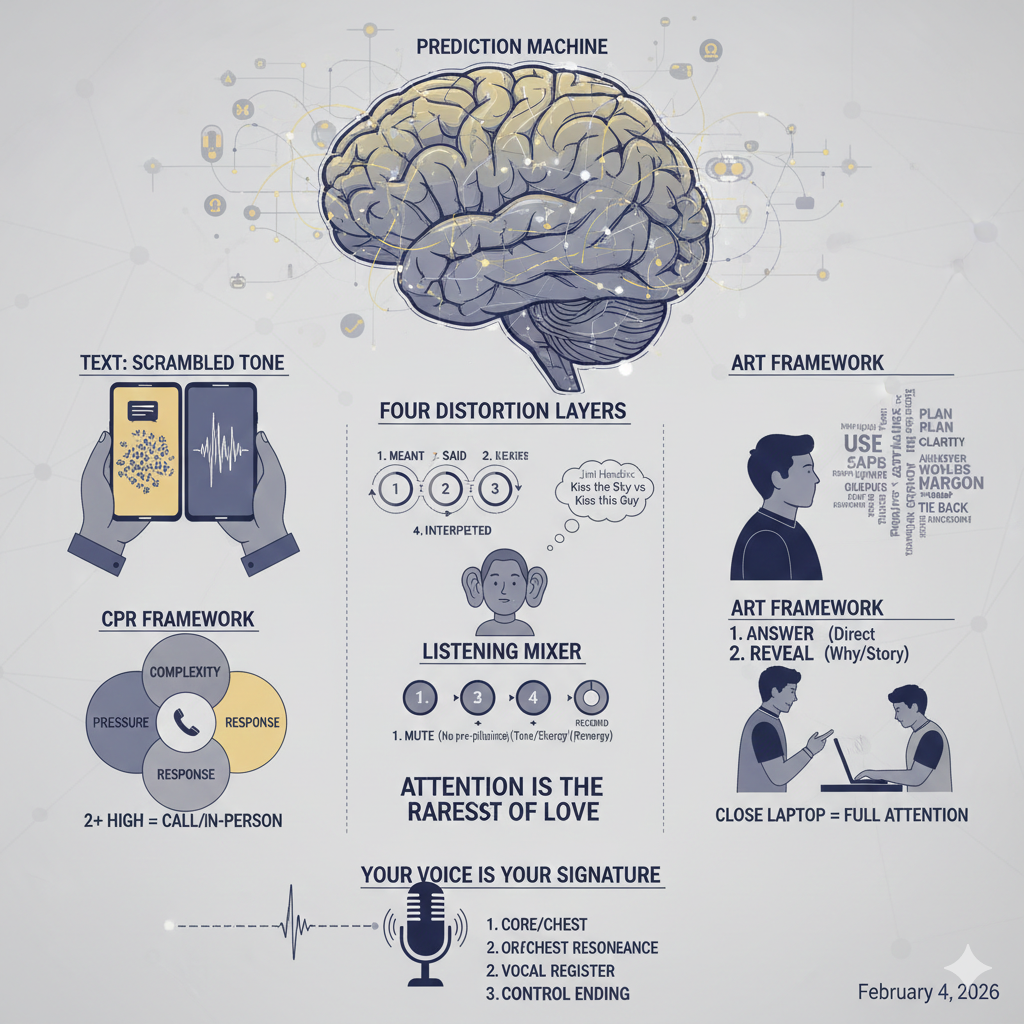
1. Communication is Fundamentally Difficult
- The human brain is a prediction machine, not a tape recorder – it fills in meaning before sentences are complete
- This pattern matching is evolutionarily wired to decrease response time and increase survival chances
- Four layers distort every message: what you meant → what you said → what they heard → what they interpreted
- Example: Jimi Hendrix sang “While I Kiss the Sky” but millions heard “while I kiss this guy”
2. The Medium Complicates the Message
- General rule: call when it matters, text when it’s safe
- Tone doesn’t travel through text – meaning gets scrambled through the medium
- CPR Framework for choosing the right medium:
- Complexity – is the topic complex?
- Pressure – are the emotional stakes high?
- Response – does it require a two-way conversation?
- If at least two of these three are high, pick up the phone or meet in person
- Many misfires and drama could be avoided by having real conversations instead of texting
3. True Listening Requires Full Presence
- Most people don’t really listen – they’re just waiting for their turn to talk
- Listening is a full body-mind connection of being there for that person
- If you want them to understand you, they first have to feel understood
- Listening Mixer Framework (four buttons):
- Mute – Don’t think about what you’ll say next while they’re speaking
- Pause – After they’re done talking, take a breath and let there be silence
- Record – Read their tone, energy, and emotion; mirror what they’ve said to build trust
- Playback – Only now speak, in the same emotional key
4. Don’t Hide Behind Your Words
- Some people hide behind humor, sarcasm, or jargon instead of being direct
- Cognitive load theory: the harder someone has to work to understand you, the less they will remember
- Simplify language immediately:
- Say “use” instead of “leverage”
- Say “plan” instead of “strategy”
5. Don’t Panic Under Pressure
- Most people ramble instead of directly answering tough questions
- ART Framework for speaking clearly under pressure:
- Answer – Answer the question directly and precisely first; don’t build up to the punchline
- Reveal – Add a reason, story, or insight; explain the why behind the what
- Tie it back – Loop back to the original question and show clarity
- Use this in job interviews, tough client calls, or boardroom situations
- Clarity becomes a gift to everyone in the room
6. What to Do When You Freeze
- Personal example: As a young equity analyst, the speaker completely froze during a high-stakes client call and hung up
- Panic hijacks your brain – the prefrontal cortex goes offline
- Recovery process:
- Do deep breathing to calm down
- Center yourself
- Own your mistakes
- Find a solution
- High performers don’t shine because they never panic – they shine because they don’t fall apart when it happens
- Presence beats perfection
7. Your Voice is Your Signature
- The quality of your voice starts with the quality of your breath
- Three key practices from an opera singer:
- Speak from your core, or at least from your chest to improve resonance
- Find your right vocal register that makes your voice sound attractive
- Control the ending – avoid the “question mark” style where every sentence ends at a high note, as human ears equate this to questioning
- Simple practice: Record yourself (audio/video), listen to it, review it, and apply these three ideas
- Your voice is your instrument in business, leadership, and life
8. Attention is the Rarest Form of Love
- Most memorable communication moments are simple: “I have a dream” – four words etched in America’s psyche
- Words matter because we can feel the presence and emotion behind them
- Personal practice as CEO: Close the laptop or physically turn away the computer screen when someone walks into the office to signal full attention
- Attention is the rarest form of love
- Generosity makes you the best communicator
- Focus on the next conversation fully and without judgment – that one conversation could change someone’s life